
XYC Metalworks
V-Grooving Stainless Steel: How ±0.01 mm Precision and 6,200 mm Length Shape Architectural Metal Panels

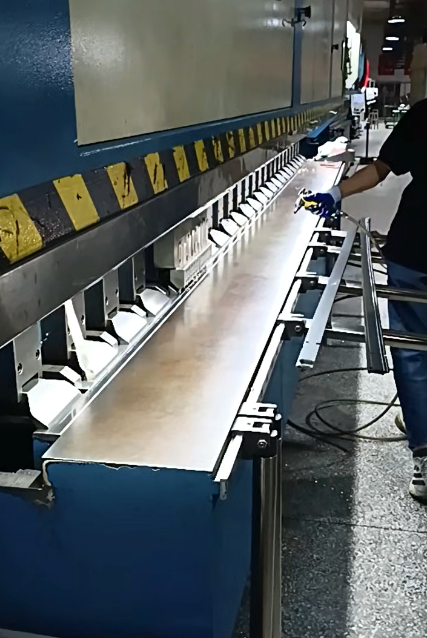
Sharp corners. Flawless surfaces. That’s what architects and specifiers see in a finished stainless steel column cover, elevator interior or lobby wall panel.
What they don’t see is the process that makes it possible: a V-shaped channel machined along every bend line, measured in hundredths of a millimeter.
This article breaks down precision V-grooving — what it is, why it matters for architectural stainless steel fabrication, and how we achieve 6,200 mm grooving length at ±0.01 mm tolerance at XYC Metalworks.
Precision V-grooving on a 6,200 mm stainless steel sheet — groove depth and position held to ±0.01 mm.
What Is V-Grooving (V-Cut Grooving)?
V-grooving, also called V-cut grooving or notching, is a precision machining process performed on a sheet metal grooving machine (刨槽机). A V-shaped cutter removes material along the fold line of a metal sheet before bending.
The result: when the sheet is subsequently folded on a press brake or bending machine, the corner closes almost completely — producing a near-sharp, 90-degree edge instead of the rounded radius you get from conventional bending alone.
V-Grooving vs. Conventional Bending: The Core Difference
| Parameter | Conventional Bending | Precision V-Grooving |
| Corner radius (inside) | 2–3 mm typical | Near-zero (near-sharp) |
| Surface effect at corner | Visible radius, possible “orange peel” | Crisp, mirror-like edge |
| Decorative face integrity | Can be distorted | Fully protected |
| Best for | General fabrication | Architectural & decorative panels |
| Max sheet length | Equipment-dependent | Up to 6,200 mm |
For architectural metal applications, that difference is not cosmetic — it is the entire point.
Why V-Grooving Matters in Architectural Stainless Steel
1. Sharp Corners Are a Design Requirement, Not a Preference
In high-end interiors, the corner is the detail people notice. Column covers (包柱), elevator car interiors, reception desks, wall cladding and door frames all rely on crisp 90° edges to read as “architectural” rather than “sheet metal.”
A 2 mm radius is invisible on a bracket. On a mirror-polished stainless steel column cover, it reads as a soft, amateur edge.
2. The Decorative Surface Must Survive the Process
Architectural stainless steel is usually finished in hairline (brushed), mirror (No. 8), PVD coated, or etched finishes. These surfaces are the product.
V-grooving machines the inside of the fold line, leaving the decorative face completely untouched. That makes it the only reliable way to bend No. 8 mirror or PVD-coated panels without damaging the visible surface.
3. Long Panels Demand Long Grooving Capacity
Modern lobby walls and elevator shafts call for joint-free, full-length panels. A 6-meter wall panel with a visible seam every 3 meters looks unfinished.
That is why grooving length is a hard capability limit, not a nice-to-have:
Our grooving capacity: up to 6,200 mm per single continuous pass.
Panels up to 6.2 meters are grooved in one setup — no re-clamping, no alignment drift, no mid-panel joint.
4. Tolerance Controls Everything on Long Panels
Here is the engineering reality most buyers miss:
On a 1-meter panel, a 0.1 mm deviation in groove position is invisible. On a 6-meter panel, that same 0.1 mm deviation accumulates into a visibly wavy corner line. The eye detects straightness deviations of roughly 0.05–0.1 mm per meter on a reflective surface.
That is why we hold groove depth and position to ±0.01 mm — one hundredth of a millimeter.
For a 6,200 mm panel, this tolerance is what separates a corner that looks machined from one that looks fabricated.
Our V-Grooving Capability: Technical Specifications
| Specification | Value |
| Workpiece length | 300 – 6,200 mm (single continuous pass, no re-clamping) |
| Workpiece width | 9 – 1,600 mm |
| Sheet thickness range | 0.3 – 6.0 mm |
| Tolerance (groove depth & position) | ±0.01 mm |
| Worktable flatness | ≤ 0.02 mm, independently adjustable |
| Grooving speed | 4 – 38 m/min, servo-driven |
| Materials | Stainless steel (304 / 316 / 316L), carbon steel, aluminum, copper & copper alloys |
| Surface finishes | Hairline, mirror (No. 8), PVD, etched, embossed |
| Bending follow-up | CNC press brake, matched to groove geometry |
| Typical applications | Column covers, elevator interiors, lobby wall panels, façade trims, reception desks |
Our equipment: the V-grooving line is built around a Guohui GHNCV-2-6200 CNC dual-groove V-grooving machine (13.5 kW), commissioned in June 2024. As a dual-head system it can cut two parallel grooves in a single pass (minimum groove spacing 80 mm), nearly doubling throughput on panels with paired bend lines — a common geometry on column covers and cladding cassettes.
How the ±0.01 mm tolerance is achieved:
- CNC servo positioning — groove location is servo-numerically controlled with dual-screw synchronous drive, keeping groove lines parallel over the full 6.2 m bed
- Hydraulic clamping & feeding — hydraulic jaws grip and feed the sheet without slipping or marking the surface
- Precision worktable — independently adjustable table with flatness controlled to 0.02 mm; the rear support platform is tied together with tensioned tubes to keep long sheets flat and free of distortion
- Rigid gear-rack drive — the cutter head rides on hardened alloy gear-rack transmission for low-vibration, stable grooving at speeds of 4–38 m/min
- Automated spray cooling — mist cooling protects the tool edge, keeping groove geometry consistent across long production runs
- In-process verification — first-off inspection plus periodic spot checks during long runs
- Matched bending — groove depth is calculated against material thickness and the target inside radius, so every fold closes exactly to spec
Applications: Where V-Grooved Stainless Steel Is Specified
Architectural & Interior
- Column covers / column cladding — sharp vertical corners on structural columns
- Elevator car interiors & door surrounds — mirror and hairline panels with tight edges
- Lobby & feature wall cladding — joint-free long-format panels
- Reception desks & retail fixtures — crisp folded edges
- Façade trims & decorative metal screens
Industrial & Equipment
- Electrical enclosures & control cabinets — sharp folded housings
- Commercial kitchen equipment — stainless housings and panels
- Laboratory furniture & cleanroom panels — smooth, contamination-free corners
- Signage & display structures
Design Considerations Before You Specify
If you are writing a spec or preparing drawings, these variables determine feasibility:
| Variable | Why It Matters |
| Material grade & thickness | Workable range 0.3–6.0 mm; determines achievable groove depth and residual web thickness |
| Target inside radius | The smaller the radius, the deeper the groove required |
| Panel length | Above ~4 m, grooving capacity becomes the limiting factor for most suppliers |
| Surface finish | Mirror/PVD finishes strongly favor V-grooving over conventional bending |
| Grain direction | For hairline finishes, groove direction relative to grain affects visual consistency |
Rule of thumb: always send the finished panel drawing, not just a description. Groove depth, bend sequence and tooling access all depend on the 3D geometry of the folded part.
Full process detail: 6-Meter Press Brake Bending: How a 130T CNC Fleet Keeps Long Architectural Panels Dead Straight
FAQ: V-Grooving Architectural Stainless Steel
What is V-grooving in sheet metal fabrication?
V-grooving (also called V-cut grooving or notching) is a machining process that cuts a V-shaped channel along the fold line of a metal sheet before bending. It allows the sheet to fold into a near-sharp 90° corner instead of the rounded radius produced by conventional press-brake bending. It is widely used in architectural stainless steel, elevator panels and decorative metalwork.
What is the maximum length for V-grooving stainless steel?
Our V-grooving capacity reaches 6,200 mm (6.2 meters) in a single continuous pass, which allows joint-free long-format panels for lobby cladding, elevator shafts and column covers. For panels longer than 6,200 mm, alternative approaches such as welded joints with post-finishing must be considered.
What sheet thickness and panel size can be V-grooved?
Our machine processes sheets from 0.3 mm to 6.0 mm thick, up to 6,200 mm long and 1,600 mm wide, in stainless steel, carbon steel, aluminum and copper. This range covers virtually all architectural cladding, column cover and elevator panel gauges, including the 1.0–3.0 mm thicknesses most commonly specified for decorative panels.
How accurate is precision V-grooving?
We control groove depth and groove position to ±0.01 mm (one hundredth of a millimeter). This tight tolerance is essential on long panels: on a 6-meter sheet, even a 0.1 mm deviation would accumulate into a visibly wavy corner line on a reflective surface.
Can you V-groove mirror-polished or PVD-coated stainless steel?
Yes — and this is one of the main reasons specifiers choose V-grooving. The process machines the inside of the fold line, so the decorative face (mirror No. 8, hairline, PVD or etched) remains completely untouched through bending.
What is the difference between V-grooving and conventional bending?
Conventional press-brake bending produces an inside radius of roughly 2–3 mm and can distort or mark the decorative surface. V-grooving removes material along the fold line so the corner closes to a near-sharp edge, with a crisp appearance and an intact decorative face.
Which industries use V-grooved stainless steel?
Architecture and interior fit-out (column covers, elevator interiors, lobby wall cladding, reception desks), commercial equipment (enclosures, kitchen equipment, laboratory furniture), signage, and any application requiring sharp folded corners on decorative metal panels.
How do I request a V-grooving quote?
Send your finished part drawings (2D or 3D) including material grade, thickness, surface finish, target inside radius and quantity. We will review feasibility, recommend groove parameters, and return a quote.
📩 Contact: sales@xycmetalworks.com | ☎ +86 189 2311 4885 | 🌐 www.xycmetalworks.com
From Raw Sheet to Architectural Panel — Under One Roof
V-grooving is one step in a chain. What matters for architects and contractors is that the whole chain — cutting, V-grooving, bending, welding, surface finishing, and quality inspection — happens under one roof, with tolerances that hold from the first panel to the thousandth.
XYC Metalworks capability summary:
- V-grooving: 6,200 mm × 1,600 mm × 0.3–6.0 mm, tolerance ±0.01 mm
- Dual-groove CNC mode: two parallel grooves in one pass
- CNC press brake bending matched to groove geometry
- Stainless steel 304 / 316 / 316L, carbon steel, aluminum, copper
- Hairline, mirror, PVD and etched finishes
- One-stop architectural stainless steel fabrication for projects worldwide
Have a project with demanding corner details? Send us your drawings for a fast, technical quote.
XYC Metalworks Co., Ltd
☎ +86 189 2311 4885
📍 No.1 Dashi Industrial Zone, Lishui, Foshan, Guangdong, China 528000
Related Reading
Article by the XYC Metalworks Co., Ltd Engineering Team. XYC Metalworks Co., Ltd specializes in precision sheet metal fabrication and architectural stainless steel solutions.