
XYC Metalworks
6-Meter Press Brake Bending: How a 130T CNC Fleet Keeps Long Architectural Panels Dead Straight

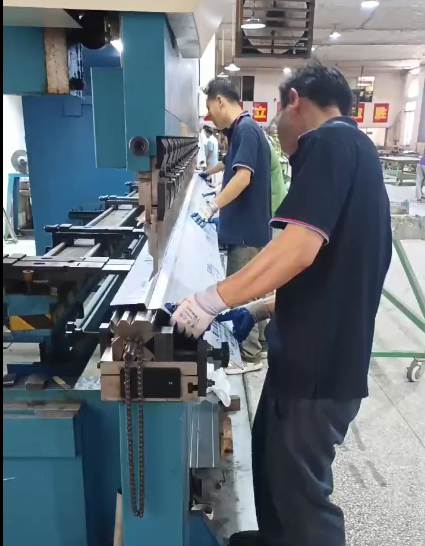
Long sheet metal bending is a different discipline from everyday press brake work. Bending a 300 mm bracket is entry-level; bending a 6-meter architectural panel — so the angle is identical at both ends and in the middle, the face stays blemish-free, and the flat area doesn’t wave in the sunlight — is where the real engineering begins.
This article explains what actually goes wrong on long-span bending, and how we control it at XYC Metalworks with a five-machine fleet of Woda DHK130T-6200 CNC press brakes — 130 tonnes, 6,200 mm bed, 0.1 mm bending repeatability, commissioned in 2024.
▶ Watch the process:
Why 6-Meter Bending Is a Different Discipline
On a short part, the press brake simply pushes the sheet into the die and the angle forms. On a 6-meter panel, three problems appear that don’t exist at 300 mm:
1. The Machine Itself Deflects
Under bending force, the ram and bed of any press brake flex minutely across its length. At the center of a 6,200 mm bend line, that deflection can reach several tenths of a millimeter — enough to produce an angle at the middle that differs measurably from the angles at the ends.
The fix is not “more tonnage.” It is deflection compensation: the CNC calculates the expected ram deflection for each bend — based on material, thickness, length and die geometry — and pre-deforms the tooling to cancel it out. Done correctly, the angle is identical from end to end. Done incorrectly or not at all, you get panels that are 89.4° in the middle and 90.2° at the corners, and nobody notices until installation day.
2. Oil-Canning on Large Flat Faces
Oil-canning — the elastic waviness that makes a large flat panel “pop” under finger pressure and shimmer under raking light — is caused by uneven residual stress in the sheet. Long bending passes, uneven clamping force and poor handling all feed it.
You cannot polish oil-canning out after the fact. It must be prevented in the bending stage: uniform force application, correct tooling width for the gauge, minimal handling, and — for the most demanding cosmetic panels — pairing bending with V-grooving, which reduces the force required to fold and therefore the stress injected into the panel (see our V-grooving guide).

3. Pre-Finished Surfaces Must Survive the Tooling
Architectural panels usually arrive at the brake already finished — PVD-coated, brushed, anodized or mirror-polished. Ordinary steel dies will mark them.
Our protocol: full-coverage protective film applied before the first bend — the entire panel, not just the bend zone — plus clean, dressed die surfaces between runs. The film stays on through bending, handling, transport and installation (every panel in our shop video carries it, through to the stacked finished goods). The surface the architect specified is the surface that shows up on site.
The Equipment: Five Woda DHK130T-6200 CNC Press Brakes
| Specification | Value |
| Machine | Woda DHK130T-6200 CNC press brake |
| Fleet size | 5 identical machines |
| Bending force | 130 tonnes |
| Max bending length | 6,200 mm |
| Bending accuracy (repeatability) | 0.1 mm |
| Commissioned | June 2024 |
| Sweet spot | 0.5 – 6.0 mm stainless steel, aluminum, carbon steel, copper alloys |
| Typical work | Facade cassettes, column covers, elevator panels, feature-wall trays, return-edge panels |
Why the fleet size matters as much as the spec sheet:
- Batch consistency — five identical machines, tooled identically, produce panels that are interchangeable. Your 400-panel order doesn’t drift between machine #1 and machine #5.
- Lead time — long panels occupy a full machine per bend. One brake = a queue; five brakes = your project ships on schedule.
- Redundancy — a machine down never stops your project.
One honest note on capability: 130 tonnes over a 6.2 m bed is optimized for thin-gauge architectural and decorative work — exactly the 0.5–6 mm range of facade and interior panels. It is not heavy-plate forming equipment, and we will tell you plainly if your part belongs on different machinery.
How We Hold 0.1 mm Across 6,200 mm for long
sheet metal bending
- CNC deflection compensation — ram crowning calculated per bend from material, thickness, length and tooling, so the angle at the center matches the angle at the ends
- Identical tooling across all five machines — one setup standard, five machines; a panel bent on Monday matches a panel bent on Friday on a different machine
- Back-gauge repeatability at 0.1 mm — flange widths stay consistent along the full bend line and across the whole batch
- Multi-operator handling for long sheets — long panels are supported by trained teams through the bend (you can see this in the video), preventing sag-induced angle error and surface contact
- First-article inspection on every batch — angle measured at both ends and the center, not just once per panel
- Film-on protocol — protective film applied before the first bend, removed only at or after installation
Where Long Sheet Metal Bending Is Specified
- Facade cladding cassettes — rain-screen panels with return edges, 3–6 m spans
- Column covers — tall formed panels, often paired with V-grooving for sharp arrises
- Elevator shaft panels & car interiors — full-height single-piece panels
- Lobby & feature walls — long trays and reveal-edge panels
- Ceiling systems & soffits — wide, shallow-formed panels where oil-canning control is critical
- Roofline, parapet & fascia — long-format external panels in stainless or aluminum
Pairing Bending with V-Grooving
For architectural panels where the corner is a design feature, bending and grooving work as a sequence:
| Step | What it does | Why it matters |
| V-grooving | Machines a channel along the fold line | Near-sharp corners, minimal folding force, decorative face untouched |
| Press brake bending | Closes the fold along the groove | Consistent angle along 6+ meters, no radius to hide |
A 6-meter panel that is grooved and bent on the same campus — with tolerances that match — avoids the classic failure mode of outsourcing these steps to different suppliers: groove lines that don’t land on the bend line.
Full process detail: V-Grooving Stainless Steel: 6,200 mm Length, ±0.01 mm Precision
Design Notes Before You Send Drawings
| Variable | Why it matters |
| Material & thickness | 0.5–6.0 mm is our bending sweet spot; it sets minimum flange and bend radius |
| Bend-line length | Up to 6,200 mm in one pass; longer panels need staged bends or joints — plan for it early |
| Return-edge depth | Deep returns (30 mm+) improve panel stiffness and resist oil-canning on wide faces |
| Finish stage at bending | Pre-finished panels (PVD / brushed / anodized) go through our film-on protocol — tell us the finish before production, not after |
| Angle tolerance expectations | ±0.1 mm repeatability is achievable; specify where it matters rather than blanket-tolerancing the drawing |
| Sequence | Groove → bend → weld → finish gives the best cosmetic result on sharp-corner panels |
FAQ: Long-Panel Press Brake Bending
What is the maximum sheet length you can bend?
6,200 mm in a single pass on our Woda DHK130T-6200 press brakes. This covers most architectural facade cassettes, column cover panels and full-height interior panels. For long sheet metal bending beyond 6,200 mm, the routes are staged bending or fabricated joints — we advise on the best option at quotation stage.
How accurate is your bending?
Bending repeatability is 0.1 mm — held across the full 6,200 mm bend line via CNC deflection compensation, and kept batch-consistent because all five of our brakes are identical machines with identical tooling. For context: our V-grooving runs at ±0.01 mm; bending accuracy at 0.1 mm is the industry-appropriate standard for architectural panel work.
What is oil-canning and can you prevent it?
Oil-canning is the elastic waviness on large flat panel faces, caused by uneven residual stress. It cannot be fixed after bending — only prevented: uniform bending force, correct tooling for the gauge, careful handling, sufficient return-edge depth, and V-grooving where sharp corners allow lower folding force. We control all of these in-house.
Can you bend pre-finished or PVD-coated panels without damaging them?
Yes. Panels are protected with high-durability film over the entire surface before the first bend, and the film stays on through bending, handling, transport and installation; dies are kept clean and dressed between runs. This is standard procedure for our PVD, brushed, anodized and mirror work.
Why does having five identical press brakes matter for my project?
Three practical reasons: batch consistency (identical machines and tooling mean panel #400 matches panel #1), shorter lead times (long panels tie up a machine per bend; five machines run in parallel), and schedule security (no single point of failure).
What materials and thicknesses can you bend?
Stainless steel (304 / 316 / 316L), aluminum, carbon steel and copper alloys in the 0.5–6.0 mm range — the standard gauges of architectural cladding, elevator and interior panel work.
Can you both V-groove and bend the same panel?
Yes — and that is exactly how our sharpest-corner architectural panels are made. Grooving and bending on the same campus means the groove line always lands exactly on the bend line, with matching tolerances at both steps.
How do I get a bending quote?
Send the finished part drawings (2D or 3D) with material, thickness, finish and quantity. We review bend feasibility, flag any oil-canning or tolerance risks, and return a technical quote — including our recommendation on whether the panel should be grooved, simply bent, or both.
📩 Contact: sales@xycmetalworks.com | ☎ +86 189 2311 4885 | 🌐 www.xycmetalworks.com
From Sheet to System — Under One Roof
Laser cutting, V-grooving, bending, welding, PVD coating and final inspection all happen on one campus in Foshan, Guangdong. For architects and facade contractors, that means one accountable partner from raw sheet to installed panel — and tolerances that match between every process, because every process is under the same roof.
XYC Metalworks Co., Ltd
☎ +86 189 2311 4885 ·
📍 No.1 Dashi Industrial Zone, Lishui, Foshan, Guangdong, China 528000
Related Reading
Article by the XYC Metalworks Co., Ltd Engineering Team. XYC Metalworks Co., Ltd specializes in precision sheet metal fabrication and architectural stainless steel solutions.